HARMONY DISPUTE RESOLUTION SERVICES BLOG

Welcome. This blog will share the latest information related to conflict resolution programs and innovations, along with peace building initiatives in Jamaica and throughout the world. Harmony DRS is a product of Jamaican talent, industry, knowledge and creativity. Our passion is sharing what we know to help facilitate better relationships and bring the world around us one step closer to perfect harmony. Join us, cheer us on, follow us and support our venture.

Friday, October 28, 2011

Evaluative and Directive Mediation: All Mediators Give Advice--Part 2 of 2


by John Wade

 
John Wade
Here are some of the pros and cons of the various schools of “evaluative mediation”.
Advantages of Evaluative Mediation
Evaluative mediation (and hybrids thereof):
  1. Provide a short form of mini-trial unencumbered by the many procedural rules attached to a full court process. Thereby there is often helpful clarification of alleged facts, evidence, rules and monetary ranges, which have previously been blurred by noise and tactics.
  2. Provide a fresh insight into how an outsider, in a role play as a judge, may view certain aspects of the dispute. Yet mediation also enables a disputant to “back-out” if (s)he does not agree with the mediator’s opinion.
  3. Provide a helpful second opinion when one or more of the disputants are not listening to their “first” expert.
  4. Appear to provide relatively fast and cheap production-line settlement of thousands of negotiations between personal injury claimants and insurers.
  5. Give justification for middle managers to settle disputes with the seal of approval of an expert. (“The mediator confirmed that the outcome is in the normal range”).
  6. Provide a comfortable environment for lawyers who are experienced with handling discussions about alleged facts, evidence, rules, monetary ranges, advice-giving officials, and shuttle negotiations.
  7. Are the only models of mediation experienced by many lawyers and give the lawyers “control” of both content and process. Therefore any other models are usually resisted.

Disadvantages of Evaluative Mediation include:
  1. Some disputes, especially those involving ongoing relationships, are unhelpfully referred by habit to evaluative mediation (“misdiagnosis”).
  2. Many lawyers have not been exposed to different models of mediation, and are not motivated to have such experiences with unknown risks to clients (chicken and egg). They do not have a stable of mediation “types”.
  3. Once at an evaluative mediation, the mediator by habit may do minimal preparation, and allow the negotiation to continue on the lines of alleged facts, evidence, rules and monetary ranges. This habit fails to systematically analyse other causes, risks and goals, appropriate interventions, and other than monetary solutions.
  4. The tendency to favour shuttle negotiations and lawyer control. Thereby key information exchange and brainstorming between the disputants in joint meetings does not take place.
  5. These first four disadvantages have led many (important?) clients to label their experience of mediation as “ isolating”, “lawyer dominated”, “unhelpful”, “a waste of time”, “too focussed on money”, and worst of all for any service industry—“not –to-be-repeated”. As lawyers “lost” the businesses of tax advice and litigation, will they also gradually “lose” the mediation sector of the market to more diverse and client-oriented providers?
  6. Importantly, evaluative mediators move between the negotiating groups or tribes carrying messages, offers and persuasion to “move”. Therefore, by strategy and habit, each group lies to the mediator about alleged facts, evidence, rules and monetary ranges on each “line” of the negotiation. Then the mediator routinely carries lies and deception. (S)he is deceived by the sender; and distrusted by the receiver. Accordingly, the mediator usually rewords or softens each message in ways unknown to the sender—“This is their first offer”; “ Their current view is---“. Thereby the usefulness of the mediator as a trusted adviser decreases; and each party carefully hides any life or business goals from the mediator, fearing that (s)he will “leak” in his/her role as persuader in the other room. Standardly lawyers ask the mediator to “leave the room”, so that they can have the allegedly “real” and confidential conversations with their clients about their actual goals and risks, before resuming the deceptive role play when the mediator returns!
  7. Evaluative mediators who rely predominantly on their substantive expertise become unemployable outside that narrow specialised area. This is not a problem where there is a steady flow of work in that area.
Anecdotally, the most employed evaluative mediators also appear to be highly competent in “process” and “people” skills. If this last sentence is more than anecdotally correct, there is yet another overlap between the “types” of mediation, and the behaviour of all regularly hired skilled helpers.

Conclusion and Prediction
As mediation continues to be used in interesting and different ways in many areas of conflict, remarkable diversity in practice is inevitable. The labels for mediation will probably expand beyond twenty—still well short of the over 400! “types” of therapeutic counselling. Evaluative mediation and an array of derivative hybrids will continue to be popular both with some users and funding bodies.
This pattern will lead to some minor turf struggles, and unhelpful attempts to create mini-monopolies by certain mediators and trainers.
The writer is confident that with the passage of time, repeat users of mediation services will slowly expand their repertoire of “types” of mediation and personalities of mediators, and use more sophisticated diagnosis and preparation to match the “right” disputes with the appropriate mediation service and personality.

Read Part 1 of this article here.

Tuesday, October 18, 2011

Know the Signs of Domestic Violence

October is Domestic Violence Awareness Month. Please see the following article from WebMD on the signs of Domestic Violence.

Domestic Violence - Signs of Domestic Violence

Most relationships have difficult times, and almost every couple argues now and then. But violence is different from common marital or relationship problems. Domestic violence is a pattern of abuse that a partner-former or current partner, spouse, or boyfriend or girlfriend-uses to control the behavior of another.
Domestic violence often starts with threats, name-calling, and slamming doors or breaking dishes, and it builds up to pushing, slapping, and other violent acts. See more types of abuse. If you are concerned about your relationship, ask yourself the following questions.
Does your partner:
  • Embarrass you with put-downs?
  • Look at you or act in ways that scare you?
  • Control what you do, who you see or talk to, or where you go?
  • Stop you from seeing your friends or family members?
  • Take your money or paycheck, make you ask for money, or refuse to give you money?
  • Make all of the decisions?
  • Tell you that you're a bad parent or threaten to take away or hurt your children?
  • Threaten to commit suicide?
  • Prevent you from working or going to school?
  • Act like the abuse is no big deal or is your fault, or even deny doing it?
  • Destroy your property or threaten to kill your pets?
  • Intimidate you with guns, knives, or other weapons?
  • Shove you, slap you, choke you, or hit you?
  • Threaten to kill you?
If any of these things are happening, you need to seek help. It's important to know that you are not alone. The way your partner acts is not your fault. Help is available.
Signs that someone you know is being abused
Do you have a friend, coworker, relative, or neighbor who you think may be in an abusive relationship?
Signs to watch for:
  • Bruises or injuries that look like they came from choking, punching, or being thrown down. Black eyes, red or purple marks at the neck, and sprained wrists are common injuries in violent relationships. An injury such as bruised arms might suggest that a victim tried to defend herself or himself.
  • Attempting to hide bruises with makeup or clothing
  • Making excuses like tripping or being accident-prone or clumsy. Often the seriousness of the injury does not match up with the explanation.
  • Having few close friends and being isolated from relatives and coworkers and kept from making friends
  • Having to ask permission to meet, talk with, or do things with other people
  • Having little money available; may not have credit cards or even a car
Other warning signs:
  • Having low self-esteem; being extremely apologetic and meek
  • Referring to the partner's temper but not disclosing the extent of the abuse
  • Having a drug or alcohol abuse problem
  • Having symptoms of depression, such as sadness or hopelessness, or loss of interest in daily activities
  • Talking about suicide or attempting suicide. For more information, see warning signs of suicide. Encourage this person to talk with a health professional.
Be supportive, and let your friend know that you are there to listen and help. For more information, see the section How To Help.
WebMD Medical Reference from Healthwise
Last Updated: November 17, 2010
This information is not intended to replace the advice of a doctor. Healthwise disclaims any liability for the decisions you make based on this information.

Tuesday, October 11, 2011

A Global Spin on Jamaican Politics

Can a Young Prime Minister Reform Jamaica's Old Criminality?

When Jamaican Prime Minister Bruce Golding announced his resignation last month, the only surprise was that it took him so long. Since last year, Golding, leader of the Jamaica Labor Party (JLP), has been embroiled in one of the worst scandals to hit Jamaica since it won independence five decades ago. His government faces accusations that for months it refused to arrest and extradite Jamaican drug lord Christopher "Dudus" Coke to the U.S. because of Coke's long and close relationship with the center-right JLP. When Golding, who denies the charge, finally did agree to collar Coke in May of 2010, it sparked a lengthy, armed street battle between security forces and Coke supporters that left 76 people dead.

Now, fearing the Coke scandal could wreck its chances in new parliamentary elections that have to be held by December of 2012, the JLP is betting that more youthful leadership can distract Jamaican voters and clean up the venal house that Golding, 63, leaves behind. On Wednesday, October 5, JLP leaders anointed 39-year-old Education Minister Andrew Holness as their new leader and therefore Jamaica's new Prime Minister. But Holness already has a big decision of his own to make as soon as the JLP ratifies him at its convention next month: whether or not to call early elections ahead of Coke's Dec. 8 sentencing hearing in the U.S., when the kingpin might name Golding and other JLP bosses among his mafia's political protectors. "Holness will be staring at Jamaica's shadow of criminality from the start," says Jamaican-American lawyer David Rowe, adjunct professor of law at the University of Miami.

(See "Behind the War on Jamaica's Streets")

Rowe and other Jamaica watchers say pulling the sun-splashed island out from under that lawless darkness, even more than solving its heavy economic problems, has to be any new PM's priority. Heavily armed gangs like Coke's Shower Posse...    


Monday, October 10, 2011

WHO | Today is World Mental Health Day

World Mental Health Day

10 October 2011

World Mental Health Day raises public awareness about mental health issues. The day promotes open discussion of mental disorders, and investments in prevention, promotion and treatment services. The treatment gap for mental, neurological and substance use disorders is formidable especially in poor resource countries.

This year the theme is "Investing in mental health". Financial and human resources allocated for mental health are inadequate especially in low resource countries. The majority of low- and middle-income countries spend less than 2% of their health budget on mental health.

Many countries have less than one mental health specialist per one million population. Even a considerable part of the limited resources is spent on large mental hospitals and not for services delivered through community and primary health care.

We need to increase investment for mental health and to shift the available resources towards more effective and more humanitarian forms of services.


Sunday, October 9, 2011

Website Best Careers 2011: Mediator - US News and World Report

Best Careers 2011: Mediator

As one of the 50 Best Careers of 2011, this should have strong growth over the next decade

December 6, 2010

The rundown:

You might think that in a country as litigious as this, no one would be interested in something called "alternative dispute resolution," or anything that poses an alternative to litigation. But the mediation and arbitration fields continue to grow at an above-average pace, in part because the legal system is such a pricey slog. Mediation and arbitration tend to be cheaper and quicker methods for reaching resolutions. Jurisdictions seem increasingly aware of the value in mediation, as all have alternative dispute resolution programs and some now require alternative resolution among certain disputants. The nation's housing crisis—and wave of foreclosures—led a chunk of states to employ mediation in foreclosure situations, often preventing formal foreclosure proceedings.

[See a list of The 50 Best Careers of 2011.]

The outlook:

Employment in arbitration, mediation, and conciliation is expected to expand by 1,400 jobs, or 22 percent between 2008 and 2018, according to the Labor Department. That's a growth rate above the average for all occupations.

Money:

Median earnings for mediators and arbitrators were $50,660 in 2009. The lowest-paid 10 percent made $30,800 or less, while the highest-paid 10 percent made more than $109,950.

Upward mobility:

With experience, your work in alternative dispute resolutions could allow you to start your own business. In the meantime, you might focus on tackling tougher cases or specializing in a particular area, such as foreclosures.

Activity level:

Pretty low. Your work is generally done in an office, either your own or someone else's. You might be required to travel to another site.

[See a list of the best social services careers.]

Stress level:

Average. Some heated disputes may raise your blood pressure, but it's your job to stay cool.

Education and Preparation...

Read Full Article At: Best Careers 2011: Mediator - US News and World Report http://money.usnews.com/money/careers/articles/2010/12/06/best-careers-2011-mediator


Sent from HootSuite iPhone
http://hootsuite.com/iphone

Wednesday, October 5, 2011

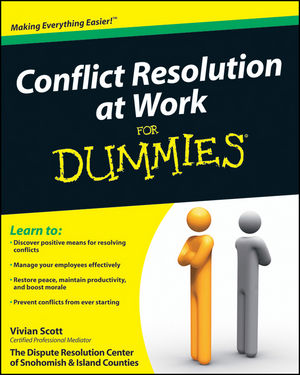
Harmony Dispute Resolution Services: Book Feature

Workplace conflict can be devastating to the parties involved and the overall productivity and efficiency of the workplace. This week we are featuring a book that looks at conflict in the workplace and how to effectively deal with it.
Below you will find a cheat sheet available via: http://www.conflictgateway.com/mediation-training-materials/126.html


Conflict Resolution at Work For Dummies

Conflict at work can be physically and emotionally exhausting, regardless of how directly you’re involved. Discover how to mediate a conflict in your workplace by following a set process and asking the right questions. And be prepared to use internal and external resources to help you resolve the conflict.

Asking Questions to Help Resolve a Workplace Conflict

When you’re dealing with a conflict between yourself and a co-worker (your boss, a peer, or a subordinate), your focus is on resolving the conflict and improving the situation. Invite the other person to sit down with you, and ask these questions:
  • What would you like to see happen? What does that look like for you? Ask these questions one right after another so your colleague can describe what he does want versus what he doesn’t want. He may ask for respect, but until he describes what respectful behavior looks like to him, you won’t know how to deliver on his request. Changing your behavior to match your definition of respect may not be what he’s looking for.
  • What would it take for us to be able to move forward? How do we get there? These questions help an employee describe specific steps that may include an apology or a better understanding of his perspective before he can get over it.
  • Are you willing to share the impact this has had on you? Are you willing to hear my perspective?Asking about a conflict’s impact moves the discussion from surface details to a working relationship level. Your colleague will appreciate your interest in him and may be more open to hearing your perspective as well. The goal is for both of you to understand the effects of actions, assumptions, and language choices.
  • What ideas do you have that would meet both our needs? The key part of this question is “both our needs.” It puts the onus for solution on both of you and shows that you’re interested in creating a remedy that isn’t just about you.
  • Can you tell me more about that? This question helps you avoid the “why” questions, which can lead to defensiveness. Show a curiosity to hear more so an employee can share his perspective without feeling like he’s on trial or your boss doesn’t misinterpret a “why” question as disrespect.
  • What about this situation is most troubling to you? What’s most important to you? Either way you ask it, this question helps you pinpoint what the real issues are (and they’re almost always based on a core value being dismissed, disregarded, or trampled on).

Tuesday, October 4, 2011

Evaluative and Directive Mediation: All Mediators Give Advice--Part 1 of 2

Evaluative and Directive Mediation: All Mediators Give Advice--Part 1 of 2

 John Wade


October 2011

John WadeWorking description
"Evaluative", "directive", "advisory" or "challenge" mediation is a common type of mediation. Like all forms of mediation, health care, engineering, lawyering and management, it has many subtypes and variables.
A working description of evaluative mediation is a dispute resolution process whereby a person with some expertise in a particular field meets with two or more disputants, encourages them to negotiate within and across their respective teams; and collects alleged facts, evidence and arguments, and gives information, opinion and advice which varies in tone, timing and content.
The expertise of the advisory mediator may be for example, in farming, building, child development, "law" generally, or some specialisation of "law".
Eventually, the different words, now used interchangeably, such as "directive", "evaluative", "advisory", and "challenge" ( there are probably more), may acquire more precise meanings and create names for various sub categories of evaluative mediation. In this paper, the words are used interchangeably.
In many countries, including Canada, USA, UK, and Australia, there are flourishing pockets of advisory mediation, particularly in routine negotiations between personal injury claimants and insurers.
Human beings are accustomed to employ alleged experts to give information, opinion and advice—doctors, plumbers, financial advisers, mechanics, etc—so it is not surprising that mediators are also employed to give various forms of advice. Many conflict resolution processes obviously have "substantive opinions" introduced  other than from a mediator.  Sometimes this results in "duelling experts" such as engineers, lawyers, valuers, doctors or anthropologists. An evaluative mediator provides two roles for the price of one—as a process facilitator of the meeting, and as (another) substantive advice-giver.
Variety of Information, Opinion and Advice
The information, opinion and advice given by many mediators ( like other professional helpers), whether offered in privacy, or in joint meetings, varies in timing, tone and content from the subtle to the very direct.
For example:
*"I'm confused"
* "Have I understood you correctly—"
* "How will you prove that --?"
*" What if your boss/judge/doctor disagrees with that statement?"
* "Which of the experts is wrong? At least one of them must be."
* "Am I correct—there are three arguments each way?"
* "That is a novel argument."
* "Your employer will have to give evidence"
* "Can I tell you what is the normal pattern in these kinds of disputes?"
* " Do you know the current statistics on how these disputes turn out?"
* " I could be wrong, but I can forsee four problems for your busines if this dispute continues."
* "There are 3 popular methods at present to value businesses."
* " On my maths, your costs exceed the probable returns"
* "Please rank what you think are your two best arguments."
* " As an outsider, only one of your arguments has impressed me so far."
* "What are the precedents for that kind of outcome."
* " Why would a judge make that kind of order?"
* " I think that you are very optimistic."
* " That suggestion does not have a snowball's chance in hell—" etc
Factors in the the Fog of Debate between Various Mediation "Types"
The flourishing pockets of evaluative mediation have led to ongoing emotional debates –often more heat than light. This is fog is dense at least because—
  1. There is an understandable tendency for commentators to compare a single type of evaluative mediation with a single type of facilitative or therapeutic mediation. Obviously, this need for stereotype misses the reality that each type has many shifting and subtle hybrids which reflect aspects of the others.
  2. The best of one form of mediation service is often compared to the worst of other "types"( "Wonder" versus "horror" stories; surgery versus chemotherapy stories).
  3. Unemployed mediators of different "schools" are predictably disappointed by gossip that other "schools" appear to be more employed.
  4. Mediation trainers tend to unjustifiably promote their own product as the "best". The majority of trainers teach facilitative or therapeutic models of mediation; and overrate their own usefulness, and discourage use of evaluative mediation types.
  5. Mediation students who have invested time and money into training, tend to faithfully insist, based on their own sunk costs, that their learned model and guru are "best".
  6. All  mediators give information and advice, despite protestations to the contrary, and have not studied the many gradations of tone, timing and content of "advice" which they are giving.
  7. It has been a convenient historic fiction for a young profession to suggest that mediators do not give "advice"---rather only information, or advice on "process". This fiction has assisted a young and developing profession to survive the fear campaigns and turf protection of older monopolies, such as ( especially) lawyers,  ("Do not give legal advice, or else---"—whatever that under- analysed concept means?); psychologists ( "Do not give advice about the emotional realm"--ouch);  financial advisers ("Do not give advice or information about financial or tax topics"—aargh);  valuers ( "Do not give information or advice on how to value anything"---woops);  cultural experts ( "Do not stumble into the multiple errors of advice giving across cultures"—oh no);  childdevelopment experts ( "Do not give advice about what is helpful for children"—but, but--); life coaches("Do not negligently reduce life conflicts to legal categories when conflict is about the meaning of life"—would I do that?); etc.
These truths, pontifications, bluffs, threats, lies and turf wars for the last 30 years have not led to a single successful lawsuit on the planet against any brand of mediator for once only or systematic boundary crossing into other alleged professional monopolies.
Arguably, the vast majority of judges are reluctant to scare mediators when these people are relieving the courts of the majority of the difficult cases languishing in their lists; when many mediators are providing dispute resolution services for the poor and middle class when no one else is doing so; judges are probably not interested in the flood of satellite disputes about what was or was not said by mediators at mediation meetings, and when this crossed some vague professional boundary, and whether any comments were the "cause" of behaviour and loss. No doubt there will be an occasional crucifixion of an evaluative mediator or two in the next few decades where the boundary crossing is blatant, and disaster follows.

READ THE FULL ARTICLE AT: http://www.mediate.com/articles/WadeJ3.cfm?nl=336

Biography


John Wade is currently a Professor of Law at Bond University. John is a nationally and internationally acclaimed expert in dispute resolution, legal education and in family law. For the last 34 years he has taught at two Australian, three Canadian and four US Law Schools. He has led over 200 courses in mediation and negotiation in UK, Hong Kong, NZ, USA and Australia. He won the inaugural awards for teaching excellence at both Sydney University and Bond University. John was one of the founding editors of the Legal Education Review and pioneered the postgraduate teaching of educational methods and theory to new law teachers.
He has published over 90 books and refereed journal articles, as well as conducting an ongoing clinical practice in mediation and in family law. He is a regular consultant to state and federal law reform bodies. John is acknowledged world-wide for teaching with enthusiasm, clinical expertise and innovative interactive methods. He has had a unique and long career of expertise in legal theory, clinical practice and teaching.

Email Author
Website: www.bond.edu.au/law/centres

The views expressed by authors are their own and do not necessarily reflect the views of Resourceful Internet Solutions, Inc., Mediate.com or of reviewing editors.